Despite living in England for over 5 years now, I have to admit, I have never made up time to discover this country properly.
But I finally took a couple of days off work and a weekend to travel South West and visit some of the most incredible and stunning places this Country has to offer.
Stonehenge
The first place I visited on my road trip is Stonehenge, one of the world and best-known Neolithic Monument in Europe. Many different theories have been put forward about who built it, when, and why.

The Stonehenge we see today is the end result of several episodes of construction, after an intervening 4,000 years of destruction and decay. Various stones are fallen or missing, making the original plan difficult to understand, and in my opinion less appealing than what most people think. You can read more about it here.
Cockington
Next day, first stop is the tiny village of Cockington, Torquay, Devon. It is one of the most densely thatched villages in England. As well as its centre piece, the Grade II* listed Cockington Court, the village comprises a working forge, waterwheel, and medieval church. The stunning water meadows with a pathway connect Cockington to the seafront, and there are plenty of green spaces and walking routes (Source: www.cockingtoncourt.org).


Fowey
The trip continues toward east Devon and eventually Cornwall. The first town I encounter is Fowey (pronounced Foy). Fowey is a workaday port turned into a holiday town, with pastel-coloured houses, portside pubs and tiered terraces overlooking the wooded banks of the Fowey River. The town’s wealth was founded on the export of china clay from the St Austell pits, but it’s been an important port since Elizabethan times.


Enjoy a coffee, a fudge or a Cornish pastry in one of the nice little pubs and restaurants overlooking the riverbank before moving on to the next destination.
St Michael’s Mount
Day three starts with a visit to a real surprise…I never realized that Cornwall is home of a small tidal island called St. Michael’s Mount.
The island is a civil parish and is linked to the town of Marazion by a man-made causeway of granite setts, passable between mid-tide and low water. It is managed by the National Trust, and the castle and chapel have been the home of the St Aubyn family since approximately 1650.


Historically, St Michael’s Mount was a Cornish counterpart of Mont Saint-Michel in Normandy, France (with which it shares the same tidal island characteristics and the same conical shape, in spite of being much smaller, at 57 acres, than Mont St Michel which covers 247 acres), when it was given to the Benedictine religious order of Mont Saint-Michel by Edward the Confessor in the 11th century.
St Michael’s Mount is one of 43 unbridged tidal islands that one can walk to from mainland Britain. Part of the island was designated as a Site of Special Scientific Interest in 1995 for its geology.
During the 6th century, before a castle was built, according to a legend, the island St. Michael’s Mount sits upon was once home to an 18-foot giant named Cormoran, who lived in a cave with his ill-gotten treasures obtained by terrorizing local towns and villages. That is, until a young farmer’s son named Jack took on this gigantic menace, who had an appetite for cattle and children, and killed him by trapping him in a concealed pit, bringing down his axe upon his head. When he returned home, the elders in the village gave him a hero’s welcome, and henceforth, called him “Jack the Giant Killer“. (Source: Wikipedia.org)
Falmouth
I leave this pleasant surprise and keep driving south-west toward Falmouth where I’d spend two nights. This city is located in a strategic position, which allows me to make day trips to the furthermost coast villages in Cornwall without being too far out of my route.


In 1688, Falmouth was made the Royal Mail packet station. In 1805, the news of Britain’s victory (and Admiral Nelson’s death) at Trafalgar was landed here at the steps of Fishstrand Quay from the schooner H.M.S. Pickle and taken to London by stagecoach.
The development of Falmouth Docks began in 1858 with the first ship entering in 1861. The railway reached the town soon after, in 1863. This brought prosperity and also tourism to the town. Perhaps surprisingly, Falmouth boasts three railway stations; Falmouth Docks, Falmouth Town and Penmere.
Many notable sailing achievements have taken place in Falmouth waters, with perhaps the two most well known being Robin Knox-Johnston’s, who became the first person to sail single handed and non stop around the world in 1969 and Ellen Macarthur’s who did it in 2007, becoming the fastest person in the process, to do so.
I haven’t had enough time to explore this city more, because I have few more places to discover in this Region.
Land’s End
Next one on my list is Lan’d End. It is the most westerly point of mainland Cornwall and England, situated within the Penwith peninsula about eight miles (13 km) west-south-west of Penzance at the western end of the A30 road.[3] To the east of it is the English Channel, and to the west the Celtic Sea.


The cliffs are made of granite, an igneous rock, which means they are resistant to weathering, and have steep cliff faces. There are two varieties of granite represented at Land’s End. Adjacent to the hotel the granite is coarse-grained with large phenocrysts of orthoclase, sometimes more than 5 in (13 cm) in length. To the north, at the First and Last House, there is a finer grained granite with fewer and smaller phenocrysts, and the different granites can be seen from a distance by the smoother weathering of the finer variety. Land’s End is a popular venue for rock climbers.
The Longships, a group of rocky islets are just over 1 mile (1.6 km) offshore, and together with the Seven Stones Reef and the Isles of Scilly which lie about 28 miles (45 km) southwest — are part of the mythical lost land of Lyonesse, referred to in Arthurian literature (Source: wikipedia.org).
St Ives
St Ives is a fishing harbor and seaside town on the north coast of Cornwall. Wander through the maze of narrow cobbled streets, independent shops and fisherman’s cottages in the heart of this town.


It is an iconic town that summaries the spirit of Cornwall. One of its main attractions is the Tate Museum. Perched above Porthmeor Beach with views across the Atlantic Ocean, the gallery showcases some of the best-loved British artworks of the 20th Century alongside an ever-changing programme of exhibitions.
Eden Project
My next stop is Eden Project. Built inside an old China Clay Quarry, this open-air Biomes is located 2 km (1.2 mi) from the town of St Blazey and 5 km (3 mi) from the larger town of St Austell.
The complex is dominated by two huge enclosures consisting of adjoining domes that house thousands of plant species, and each enclosure emulates a natural biome. The biomes consist of hundreds of hexagonal and pentagonal, inflated, plastic cells supported by steel frames. The largest of the two biomes simulates a rainforest environment and the second, a Mediterranean environment. The attraction also has an outside botanical garden which is home to many plants and wildlife native to Cornwall and the UK in general; it also has many plants that provide an important and interesting backstory, for example, those with a prehistoric heritage (source:wikipedia.org).


Weymouth
My final stop is Weymouth.
Weymouth is a seaside town in Dorset, southern England. Its sandy beach is dotted with colorful beach huts and backed by Georgian houses. On the opposite side of the beach is the harbor. Its colorful houses, the fishing and sailing boats remind me of the famous Nyhavn in Copenhagen. Jurassic Skyline, a revolving viewing tower, and Victorian Nothe Fort offer harbour views. On the fossil-rich Jurassic Coast is pebbly Chesil Beach. A causeway leads to Portland Island with its lighthouse and birdlife.


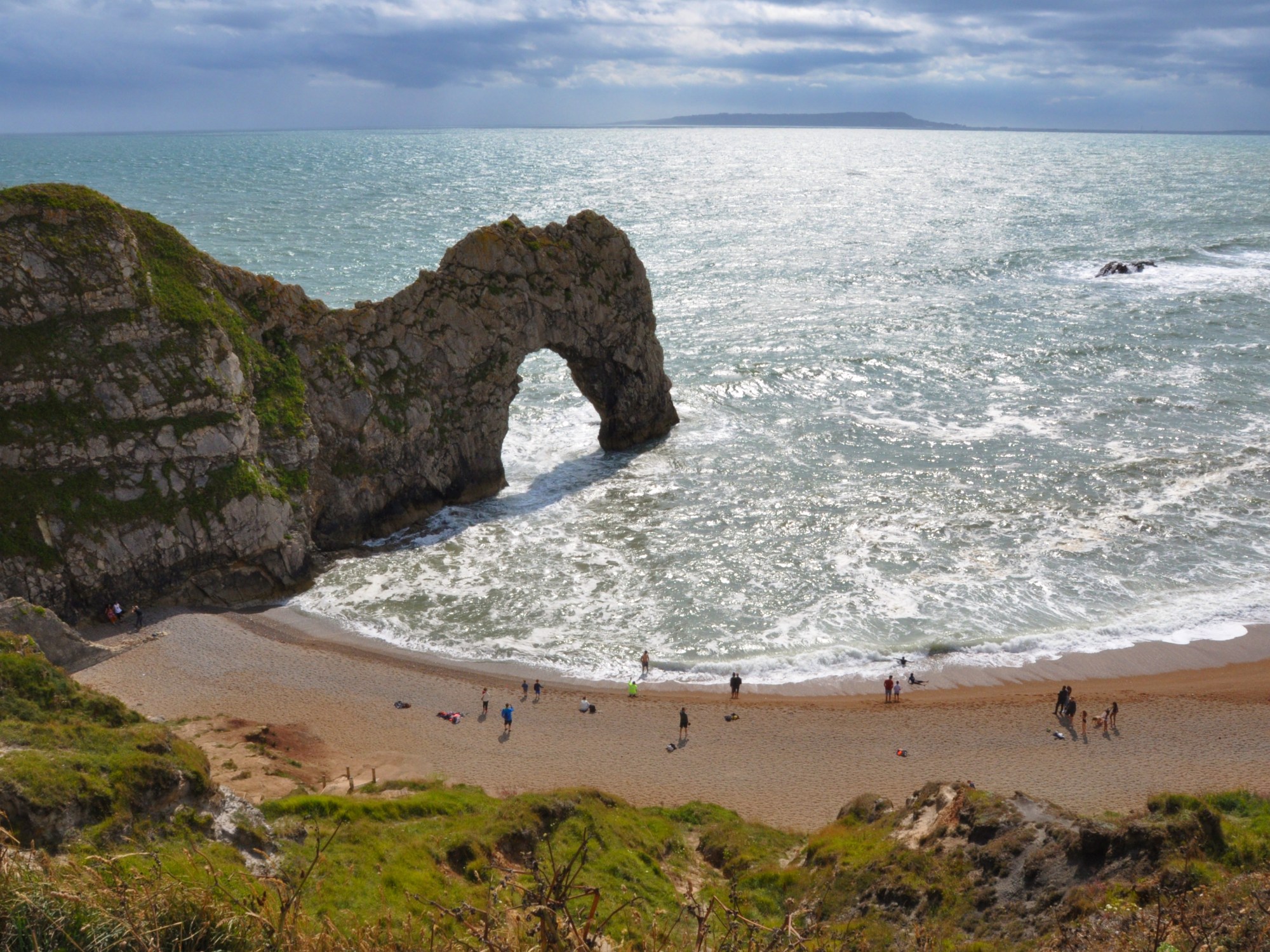
On my way back to the busy London’s life I decided to take few shots at Durdle Door, along the Jurassic Coast. This is place offers a hugely diverse and beautiful landscape underpinned by incredible geology of global importance. In 2001 it became a World Heritage Site.
The Jurassic Coast is characterized by three geological time periods called the Triassic, Jurassic and Cretaceous.
Those three time periods of Earth history collectively make up the Mesozoic Era, running from around 250 to 65 million years ago. Rocks that offer an almost complete record of that entire time are spread out along the Jurassic Coast, a bit like the pages of a book (Source: Jurassiccoast.org).


The Rock formation is visible from the viewpoint at the end of the path, which is a 10 minute walk from the car park. If you plan to visit the Jurassic Coast by car, it is a good idea to familiarise yourself with the best routes available in advance of setting out, as the roads do get busy – especially during peak holiday times. There are no motorways near the Jurassic Coast (other than the M5 coming from the north down to Exeter). Please note that if you put “Jurassic Coast” into your sat nav it will take you to a random location midway that does not have access to the beach. Please put in a specific town or location, such as Lulworth or the Durdle Door holiday park.
I hope you enjoyed this short diary of my weekend gateway from London Town.
I will make an effort to spend more time in this Country and discover all the Area of Outstanding Beauty that England has to offer.
As usual, if you have any request or if you need some specific details or advices, please contact me.
Ale
 GoldFish